Trees are an important feature of many gardens, providing structure, shade and natural character. However, trees are living organisms that continually change. As they mature, individual branches can become damaged, weakened or die while the rest of the tree continues to grow normally.
Dead branches are particularly important to identify because they no longer have the same flexibility and structural qualities as healthy living wood. Over time, weakened branches may break away, especially during strong winds or periods of difficult weather. Where trees stand close to gardens, paths, driveways, buildings or frequently used outdoor spaces, falling debris can become a significant concern.
For property owners in Portishead, Bristol, professional tree assessment and appropriate deadwood removal can help maintain safer, healthier and better-managed trees. EM Tree Surgery Portishead provides professional tree surgery tailored to the condition and surroundings of individual trees.
What Is Deadwood in a Tree?
Deadwood refers to branches or sections of a tree that are no longer living.
Branches can die for many reasons. Some die naturally as the tree develops and redirects resources towards stronger or better-positioned growth. Others may be affected by damage, shading, weather exposure or declining branch health.
A small amount of deadwood can occur naturally within many established trees. The concern increases when larger branches die or when dead material is positioned above areas regularly used by people or vehicles.
Why Are Dead Branches More Likely to Fall?
Living branches contain active tissues and generally retain a degree of flexibility. Dead branches gradually lose these characteristics.
As the wood dries and deteriorates, its attachment to the tree can weaken. Eventually, the branch may no longer be able to withstand movement or loading.
Failure can sometimes occur during:
- Strong winds
- Heavy rainfall
- Periods of difficult weather
- Movement elsewhere within the canopy
- Gradual deterioration over time
Importantly, a dead branch does not always fall immediately after dying. It can remain within the crown for a considerable period, making it easy to overlook until its condition becomes more obvious.
What Is Deadwood Removal?
Deadwood removal is a tree surgery operation involving the careful removal of dead, dying or significantly weakened branches from the tree’s crown.
The work is generally selective. Healthy branches do not need to be removed simply because deadwood is present elsewhere within the canopy.
A professional tree surgeon can assess the tree and identify which branches require attention while retaining healthy growth wherever appropriate.
This helps reduce potentially unstable material without unnecessarily altering the natural shape of the tree.
Reducing Falling Debris Around Gardens
One of the clearest reasons for removing significant dead branches is to reduce the amount of unstable material above frequently used outdoor areas.
Consider a mature tree positioned above a lawn or seating area. Even if the tree itself remains healthy, one dead branch could eventually detach and fall into the space below.
Professional deadwood removal allows vulnerable branches to be removed in a controlled manner rather than leaving them to fall unpredictably.
This can be particularly valuable in gardens where mature trees form part of the main outdoor living space.
Trees Above Paths Need Particular Attention
Branches positioned above paths deserve careful consideration because people regularly pass beneath them.
A dead branch may appear secure when viewed from ground level, but deterioration around its attachment point can be difficult to assess without appropriate knowledge and access.
Where significant deadwood is present above a regularly used route, professional assessment can establish whether removal would be beneficial.
The objective is not to remove unnecessary parts of the tree, but to manage branches whose condition creates an avoidable concern.
Dead Branches Above Driveways and Parking Areas
Trees often grow alongside driveways or areas where vehicles are regularly parked.
In these locations, falling branches can potentially damage vehicles or obstruct access. Even relatively small debris can become inconvenient when it repeatedly falls onto a driveway.
Larger dead branches require greater attention because their weight and height can significantly increase the impact if they detach.
Removing unstable deadwood can therefore be an important part of managing trees positioned around vehicle access areas.
Branches Close to Buildings
Trees close to properties require thoughtful management because branches can extend above roofs, outbuildings and other structures.
A healthy branch positioned near a building does not automatically require removal. The situation is different when a branch is dead, structurally compromised or showing signs of significant deterioration.
Professional tree surgery can selectively remove problematic deadwood while preserving suitable healthy growth.
For properties in Portishead, Bristol, this balanced approach can help homeowners retain established trees without ignoring potentially vulnerable branches.
How Can You Recognise a Dead Branch?
Some dead branches are easy to identify, while others are less obvious.
Possible indicators include:
No Leaves During the Growing Season
A branch remaining completely bare while surrounding branches are in leaf may require closer examination.
Brittle or Dry Twigs
Dead growth can become noticeably dry and fragile.
Peeling or Deteriorating Bark
Changes in bark condition may sometimes accompany branch decline.
Lack of New Growth
A section that consistently produces no buds or shoots may no longer be active.
Visible Damage
Cracks, broken sections or obvious deterioration can indicate that a branch needs professional assessment.
However, appearance alone does not always provide a reliable diagnosis. Different tree species grow differently, and some naturally retain deadwood for extended periods.
Why Ground-Level Inspection Has Limitations
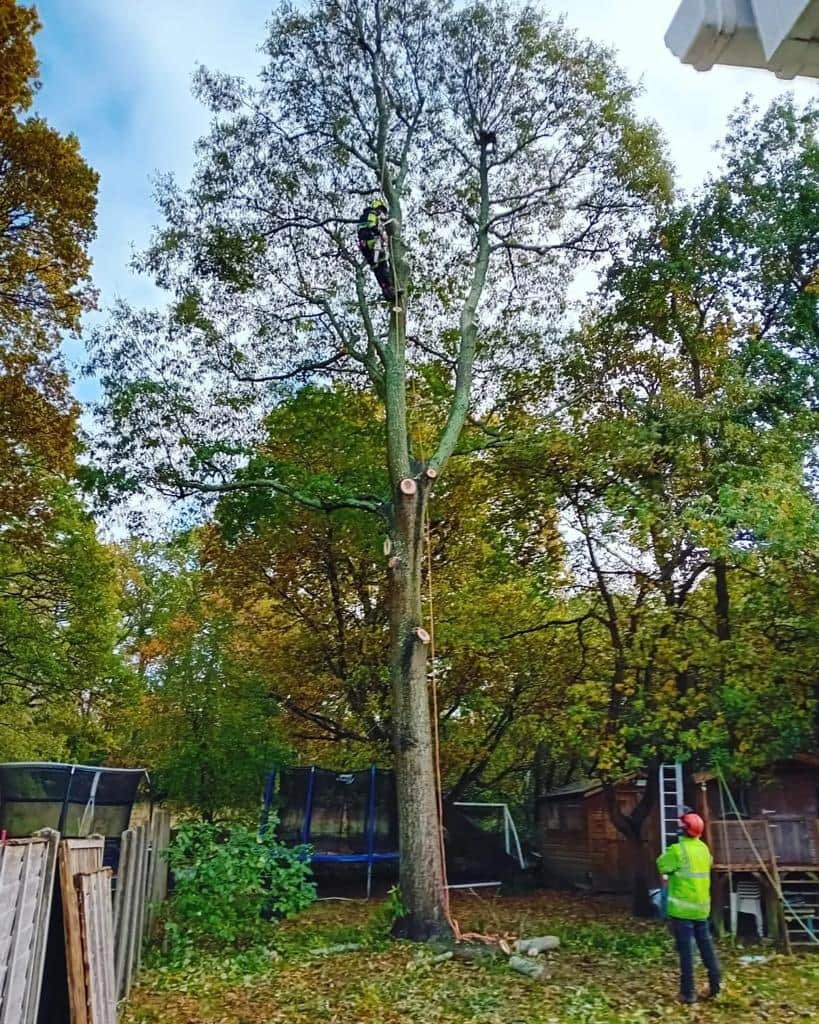
A large tree can look completely different when examined from within the crown.
Branches that appear relatively small from the ground may actually be substantial. Similarly, defects around branch unions or higher sections can be difficult to see from below.
Professional tree surgeons understand how to assess branch structure and can access areas that homeowners cannot safely inspect themselves.
This becomes particularly important where trees are tall, mature or positioned close to frequently used areas.
Deadwood Removal Can Improve the Appearance of a Tree
Safety is often the main reason for addressing significant deadwood, but careful removal can also improve the appearance of the tree.
A canopy containing numerous bare, broken or deteriorating branches can appear untidy and neglected.
Selective deadwood removal can create a cleaner crown while allowing the healthy structure to remain prominent.
The aim should not be to create an unnaturally sparse tree. Good tree surgery retains the tree’s character while removing material that no longer contributes positively to its structure.
Deadwood Removal Is Different from General Pruning
It is useful to distinguish deadwood removal from broader pruning operations.
Deadwood removal specifically targets dead, dying or significantly compromised branches.
Other pruning methods may have different objectives. Crown reduction, for example, can reduce the overall dimensions of a tree, while crown thinning selectively removes growth to alter canopy density.
A tree may require only deadwood removal rather than substantial pruning.
Professional assessment helps determine which operation actually suits the condition of the tree.
Why Dead Branch Removal Should Be Controlled
Allowing a branch to fall naturally means there is little control over when it will detach or where it will land.
Professional removal provides a controlled alternative.
Tree surgeons can plan how branches are removed according to their size, position and surroundings. This is particularly important where trees stand above gardens, driveways, buildings or other restricted spaces.
Larger sections may need to be carefully dismantled rather than simply cut and allowed to fall.
The techniques used should reflect the individual tree and working environment.
Should Every Dead Branch Be Removed?
Not necessarily.
Trees naturally contain some dead material, particularly within mature crowns. The significance of deadwood depends on factors including its size, location and condition.
A small dead twig high within a tree presents a very different situation from a substantial dead limb extending over a driveway.
Professional tree management should therefore be proportionate.
The purpose of an assessment is to identify deadwood that genuinely warrants attention rather than removing branches without a clear reason.
Regular Tree Inspections Can Identify Changes Early
Tree condition is not static.
A tree that appears healthy today may develop dead or weakened branches over time. Weather, natural growth and changing environmental conditions can all affect individual sections of the crown.
Occasional professional assessment can be particularly useful for mature trees or those positioned close to regularly used areas.
Signs worth investigating include:
- Newly dead branches
- Hanging or partially detached limbs
- Broken branches caught within the crown
- Increasing quantities of deadwood
- Cracks around major branch unions
- Significant changes in canopy appearance
Identifying these changes allows appropriate work to be considered before deteriorating branches fall naturally.
Why Professional Tree Surgery Matters
Removing dead branches from a mature tree is very different from cutting a small branch at ground level.
Working at height, managing heavy timber and making appropriate pruning cuts all require experience and suitable equipment. Incorrect cuts can also unnecessarily damage healthy parts of the tree.
At EM Tree Surgery Portishead, we assess the tree before determining which branches require attention. The surrounding garden, nearby structures and areas beneath the canopy are also considered so that the work can be carried out in a controlled and appropriate manner.
Professional tree surgery should always aim to solve the specific problem while retaining as much healthy tree structure as possible.
Conclusion
Dead branches are a natural feature of many trees, but significant deadwood can become increasingly unstable as it deteriorates. Where weakened branches extend above gardens, paths, driveways, buildings or other regularly used areas, removing them in a controlled manner can reduce the risk of falling debris.
The appropriate response depends on the size, position and condition of the deadwood. Not every dead twig requires removal, but larger or vulnerable branches deserve professional assessment, particularly when they are difficult to inspect safely from ground level.
For property owners in Portishead, Bristol, EM Tree Surgery Portishead provides professional tree surgery focused on careful assessment and appropriate tree management. If you have noticed dead, broken or deteriorating branches within a tree on your property, contact our team to arrange an assessment and determine whether professional deadwood removal is required.
Call us on: 01275 402 923
Click here to find out more about EM Tree Surgery Portishead
Click here to complete our contact form and see how we can help with your trees needs.